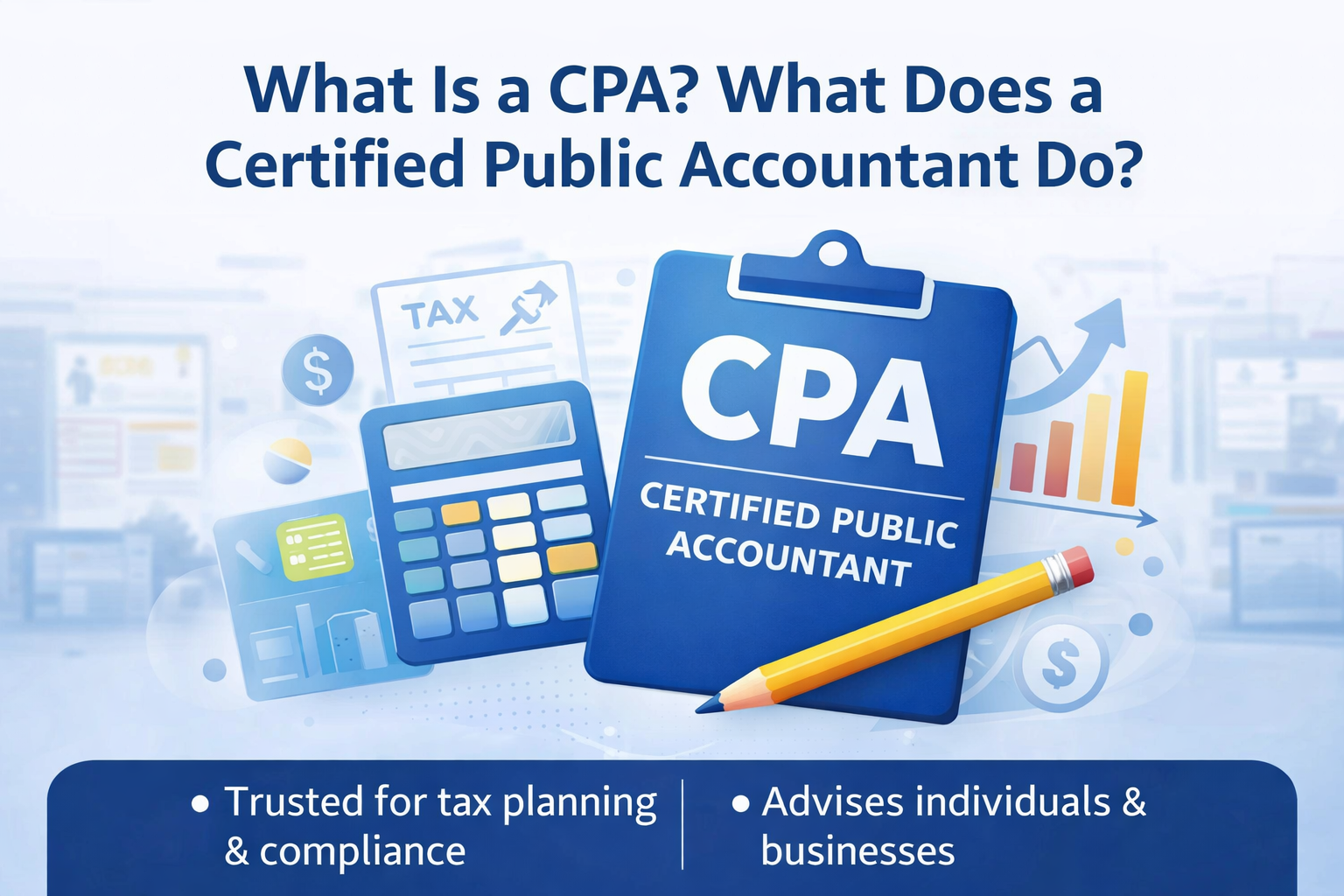
A Certified Public Accountant (CPA) is one of the most trusted financial professionals for individuals and businesses—but many people aren’t exactly sure what CPAs do or how they differ from other accountants or tax preparers. A Certified Public Accountant (CPA) is a licensed accounting professional whose credential and professional standards are supported nationally by the American Institute of Certified Public Accountants (AICPA).
This guide explains what a CPA is, what CPAs actually do, and when working with one can add real value, whether you’re an individual, a business owner, or an independent contractor.
Executive Summary
- A CPA is a licensed accounting professional held to strict education, testing, and ethics standards.
- CPAs provide tax planning, accounting, advisory, and assurance services, not just tax preparation.
- Unlike general accountants or tax preparers, CPAs are state-licensed and regulated.
- Working with a CPA is especially helpful when finances become complex, multi-state, or high-risk.
What Is a CPA (Certified Public Accountant)?
A CPA (Certified Public Accountant) is a professional who has met rigorous education, examination, experience, and ethics requirements set by a state board of accountancy.
The title “CPA” is legally protected. Only individuals who meet these requirements—and maintain ongoing education—may use it.
In simple terms:
- All CPAs are accountants
- Not all accountants are CPAs
How Does Someone Become a CPA?
To earn the CPA license, an individual must typically:
- Complete a college degree with advanced accounting coursework
- Pass the Uniform CPA Examination (four-part national exam)
- Gain relevant professional experience
- Complete continuing professional education (CPE) every year
CPAs are also bound by ethical standards and can face discipline or license loss for violations.
What Does a CPA Do?
CPAs do far more than prepare tax returns. Their work often combines compliance, planning, and advisory services.
1. Tax Planning and Tax Preparation
CPAs help individuals and businesses:
- Prepare accurate federal, state, and local tax returns
- Reduce taxes legally through proactive planning
- Navigate complex tax issues (multi-state income, business taxes, audits)
- Respond to IRS or state tax notices
👉 Learn more about Reckenen’s tax services:
- Business Tax Services: https://reckenen.com/business-solutions/
- Individual Tax Planning & Compliance: https://reckenen.com/personal-solutions/
2. Business Accounting & Advisory Services
For businesses, CPAs often provide:
- Financial statement preparation and analysis
- Cash flow and profitability planning
- Budgeting and forecasting
- Entity selection and restructuring advice
- Growth, acquisition, and exit planning
Many business owners rely on CPAs as long-term financial advisors, not just compliance providers.
👉 Learn more:
- Outsourced Accounting Services: https://reckenen.com/outsourced-accounting/
3. Audits, Reviews, and Assurance Services
Some CPAs specialize in assurance services, including:
- Financial statement audits
- Reviews and compilations
- Compliance examinations
These services are often required by lenders, investors, regulators, or nonprofit boards.
4. Specialized CPA Services
Depending on their focus, CPAs may also advise on:
- Multi-state and local tax issues
- Business valuations
- Nonprofit accounting and compliance
- Estate, trust, and gift taxation
- Payroll, sales tax, and business license taxes
CPA vs Accountant vs Tax Preparer: What’s the Difference?
| Credential | Licensed | Can Represent You Before IRS | Strategic Planning | Regulated |
|---|---|---|---|---|
| CPA | ✅ Yes (State) | ✅ Yes | ✅ Yes | ✅ Yes |
| Enrolled Agent (EA) | ✅ Yes (Federal) | ✅ Yes | ⚠️ Limited | ✅ Yes |
| Accountant (non-CPA) | ❌ No | ❌ Usually No | ⚠️ Varies | ❌ No |
| Tax Preparer | ❌ No | ❌ Limited | ❌ No | ❌ No |
Key takeaway: CPAs offer the broadest mix of technical expertise, regulatory oversight, and advisory capability.
When Should You Work With a CPA?
You may benefit from working with a CPA if you:
- Own or are starting a business
- Have multiple income sources or investments
- Need tax planning, not just filing
- Operate in more than one state or locality
- Receive a tax notice or audit inquiry
- Want proactive financial guidance
Even individuals with relatively simple finances often work with CPAs for confidence and long-term planning.
Common Misconceptions About CPAs
- ❌ “CPAs are only for wealthy people”
- ❌ “A CPA only files tax returns”
- ❌ “All accountants are basically the same”
In reality, CPAs work with individuals, small businesses, nonprofits, and growing companies across many industries.
Frequently Asked Questions
What does CPA stand for?
CPA stands for Certified Public Accountant, a state-licensed accounting professional.
Is a CPA better than a tax preparer?
A CPA is typically more qualified for complex situations because they are licensed, regulated, and trained in tax planning—not just filing.
Do I need a CPA if my taxes are simple?
Not always—but a CPA can still help with planning, compliance confidence, and future decision-making.
Can a CPA help with business decisions?
Yes. Many CPAs provide advisory services related to cash flow, growth, tax strategy, and long-term planning.
How Reckenen Supports Clients as CPAs & Advisors
At Reckenen, CPAs work closely with clients to provide:
- Clear tax planning and compliance
- Practical accounting and advisory support
- Guidance tailored to individuals, business owners, and nonprofits
Learn more or start a conversation:
- Business Solutions: https://reckenen.com/business-solutions/
- Personal Solutions: https://reckenen.com/personal-solutions/
- Contact Reckenen: https://reckenen.com/contact/