Money moves fast, so waiting weeks to see your financial data can put your business at risk. That is why real-time financial reporting has become essential for modern businesses. With instant access to numbers, you can track performance, control cash flow, and make quick decisions without delays.
At Reckenen, businesses use real-time accounting within outsourced accounting to stay ahead. This approach combines expert support with smart technology, so you always see accurate and updated financial data. As a result, you gain better control, improve planning, and grow your business with confidence.
What Is Real-Time Financial Reporting?
First, let’s understand the real-time reporting meaning.
Real-time financial reporting means you can see your financial data instantly.
Instead of waiting for monthly reports, you get updates every day or even every minute.
For example:
- Sales update instantly
- Expenses appear right away
- Profit changes in real time
So, reporting in real time helps you make quick and smart decisions.
Define Outsourced Accounting
Accounting outsourcing means a business hires an external team to manage its financial tasks instead of handling them in-house. This process includes services like bookkeeping, payroll, tax preparation, and financial reporting. As a result, outsourcing accounting helps businesses save time, reduce costs, and get support from experienced professionals.
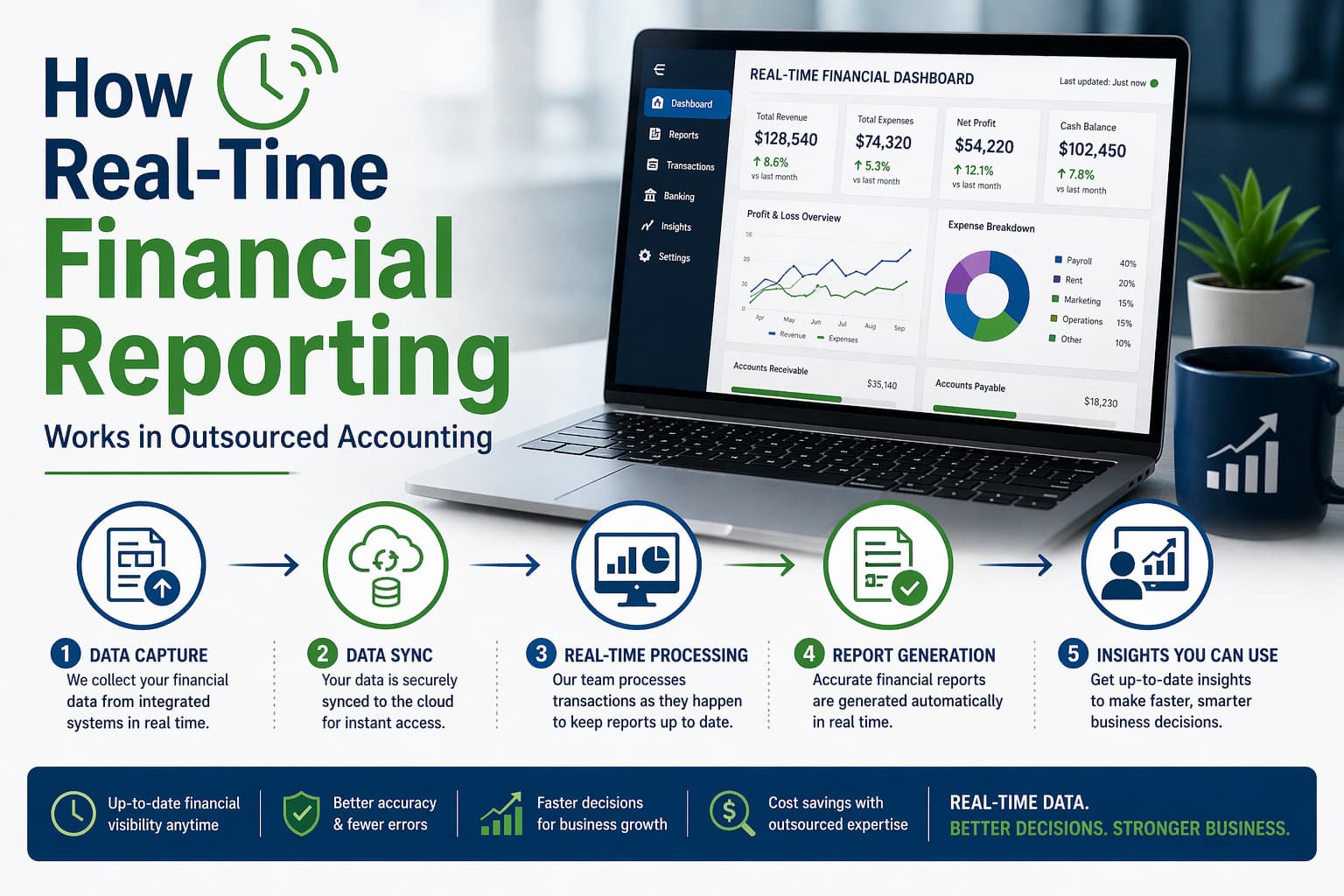
How Real-Time Accounting Works in Outsourced Accounting
When you combine real-time accounting with outsourced accounting solutions, you create a system that works faster and more accurately. As a result, businesses can track their finances without delays and make better decisions.
Here is how it works step by step:
1. Cloud-Based Systems
First, outsourced teams use modern financial reporting technology like cloud-based software. Because these systems work online, they update financial data instantly.
Because of this:
- Data updates automatically without manual work
- Teams can access information from anywhere
- Business owners stay connected with their finances
- Errors have reduced due to automation
As a result, businesses always see updated financial data instead of old reports.
2. Automated Data Entry
Next, the system records transactions instantly using automation. Instead of entering data manually, software connects directly with banks and other tools.
For example:
- Bank feeds update transactions daily or instantly
- Invoices sync automatically
- Expenses track in real time
So, real-time accounting reduces manual effort, saves time, and improves accuracy.
3. Real-Time Financial Dashboards
Then, businesses use real time financial dashboards business tools to view their financial data clearly. These dashboards show all important numbers in one place.
These dashboards show:
- Revenue
- Expenses
- Cash flow
- Profit margins
As a result, business owners understand their financial position quickly and easily.
4. Continuous Monitoring and True-Up Accounting
After that, experts review and adjust financial data regularly. This process is called true-up accounting.
It ensures:
- Numbers stay accurate and updated
- Reports match real business performance
- Errors get fixed quickly
Because of this, businesses maintain clean and reliable financial records.
5. Instant Reporting and Insights
Finally, reports generate instantly whenever needed. Instead of waiting for weekly or monthly reports, businesses access data anytime.
So instead of waiting weeks:
- You get live insights
- You make faster decisions
- You respond to problems early
- You improve financial planning
In short, reporting in real time helps businesses stay proactive and in control.
What Do Outsourced Financial Reporting Services Include?
When businesses choose outsourced accounting solutions, they get more than just reports. These services cover many important tasks that support better financial management.
Financial Statement Preparation
First, outsourced teams prepare monthly, quarterly, and yearly reports. These include balance sheets, income statements, and cash flow statements. As a result, businesses get accurate and consistent financial records.
Cash Flow Monitoring
Next, experts track how money moves in and out of the business. Because of this, companies can manage cash better and avoid shortages during busy or slow periods.
Tax Preparation
Outsourced teams also handle tax-related tasks. They prepare filings on time and identify possible deductions and credits. As a result, businesses reduce tax risks and stay compliant.
Audit Support
In addition, outsourced professionals keep financial records organized for audits. Because everything stays updated, businesses face fewer delays and handle audits more smoothly.
Forecasting and Planning
Finally, experts help with financial forecasting and budgeting. They estimate future income and expenses, so businesses can plan ahead and make smarter decisions.
Role of Real-Time Financial Reporting in Outsourced Accounting
Now, let’s look at why businesses choose to outsource finance & accounting with real-time systems. These benefits help companies stay competitive, reduce risks, and grow faster.
Better Decision-Making
Because financial data updates instantly, business owners can make quick and informed decisions. Instead of guessing, they rely on accurate numbers. As a result, they respond faster to market changes, control spending, and plan better for the future.
Improved Accuracy
With automation and true-up accounting, systems record and adjust data continuously. Because of this, errors decrease, and financial records stay clean. Also, regular checks ensure that reports match actual performance, which builds trust in the data.
Cost Savings
Accounting outsourcing for small businesses reduces the need to hire a full in-house team. Instead of paying salaries, training costs, and software expenses, businesses pay only for the services they use. As a result, they manage finances efficiently while saving money.
More Transparency
Outsourced accounts provide clear and updated financial reports at any time. Because of real-time access, business owners always know where their money goes. This transparency improves control, reduces confusion, and supports better financial management.
Business Growth
With enterprise outsourced accounting, companies gain access to expert support and advanced tools. Because they see real-time insights, they identify opportunities quickly and scale operations with confidence. As a result, businesses grow faster and stay ahead of competitors.
Outsourced Accounting for Small Businesses
Small businesses benefit greatly from accounting outsourcing for small businesses because it allows owners to focus on growth instead of daily financial tasks. By using outsourced accounting services, they avoid costly mistakes and gain access to expert advice. As a result, even small teams can use advanced tools and systems that they could not afford on their own.
Challenges of Accounting Outsourcing
However, there are some accounting outsourcing challenges.
- Communication Gaps: Sometimes, working with remote teams creates delays.
- Data Security Concerns: Businesses must protect financial data.
- Tool Integration Issues: Different systems may not sync easily.
How to solve challenges:
To solve accounting outsourcing challenges, businesses should choose reliable outsourced accounting solutions, use secure technology, and maintain clear communication. As a result, they reduce errors and improve efficiency.
Why Businesses Choose Enterprise Outsourced Accounting
Large companies prefer this because:
- They handle complex data
- They need real-time insights
- They manage multiple departments
So, outsourcing helps them stay efficient and competitive.
FAQs:
1. What is cloud-based accounting?
Cloud-based accounting is an online system where financial data is stored and updated automatically. It allows businesses to access reports anytime from any location in real time.
How does outsourcing save money?
Outsourcing saves money because businesses do not need to hire full-time staff, pay salaries, or buy expensive accounting software. They only pay for the services they use.
Can small businesses use real-time reporting?
Yes, small businesses can easily use real-time reporting. It helps them track income, expenses, and cash flow instantly, which improves decision-making and control.
Is real-time accounting safe?
Yes, real-time accounting is safe because it uses secure cloud systems, encryption, and trusted software to protect sensitive financial data.
Who benefits most from outsourced accounting?
Small and medium-sized businesses benefit the most because they get expert accounting support, better accuracy, and lower costs without hiring full-time teams.
Smarter Financial Management
Today, businesses cannot afford delays in financial reporting. That is why real-time financial reporting is so important. It helps track money instantly, fix issues quickly, and improve decision-making. As a result, businesses stay more accurate, efficient, and ready for growth. In short, real-time accounting is a smarter way to manage business finances.
Get real-time accounting solutions with Reckenen today.