
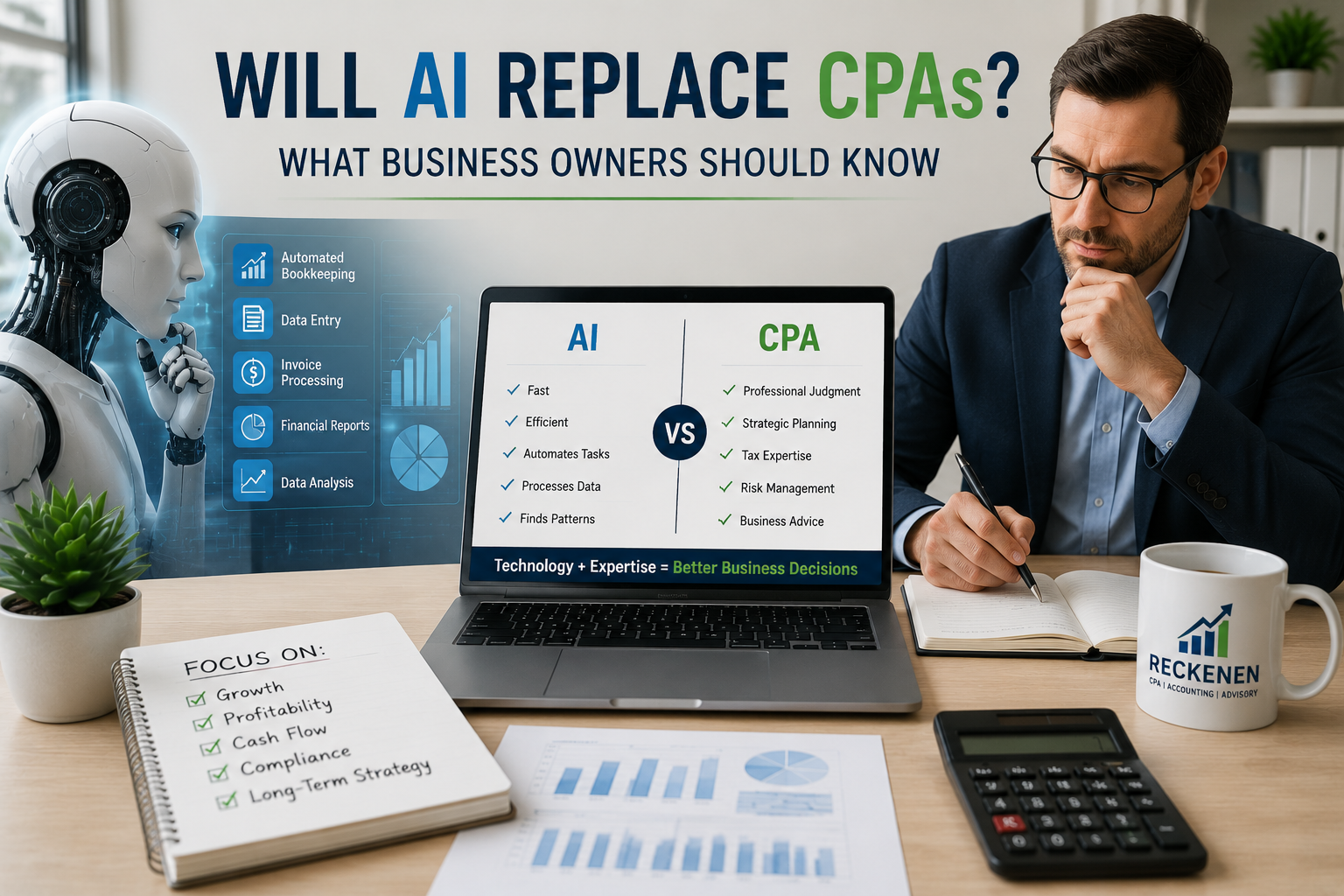
Will AI replace CPAs? The short answer is no. While artificial intelligence can automate bookkeeping, data entry, invoice processing, and certain reporting tasks, it cannot replace the professional judgment, strategic planning, and business insight that CPAs provide. Businesses still rely on CPAs for tax planning, regulatory compliance, financial strategy, risk management, and complex decision-making that requires human expertise and context.
As AI continues to reshape the accounting industry, business owners have access to faster and more efficient financial tools than ever before. However, technology works best when combined with experienced financial guidance. At Reckenen CPA, we help businesses leverage modern accounting technology while providing the personalized advice, tax expertise, and strategic support that AI alone cannot deliver. Understanding the relationship between AI and CPAs can help business owners make smarter decisions about managing their finances in an increasingly digital world.
The Growing Role of AI in Accounting
Artificial intelligence has become a valuable tool in the accounting industry. Modern accounting software can process large amounts of financial data quickly, identify patterns, and automate repetitive tasks that once required significant manual effort.
Today, AI is commonly used for:
- Automated bookkeeping
- Expense categorization
- Invoice processing
- Bank transaction matching
- Financial reporting
- Cash flow monitoring
- Fraud detection
- Data analysis
As technology continues to improve, businesses can gain faster access to financial information and reduce administrative workloads.
How AI Is Transforming the Accounting Profession
AI is changing how accounting work gets done. Instead of spending hours entering transactions or organizing financial data, accountants can focus more on analysis, planning, and advisory services.
Automation of Routine Tasks
Many bookkeeping tasks follow predictable rules. AI-powered systems can automate data entry, categorize expenses, reconcile transactions, and generate reports with minimal human involvement.
As a result, businesses often save time and reduce manual errors.
Improved Efficiency
AI can process financial information significantly faster than manual methods. Consequently, businesses receive financial reports more quickly and gain better visibility into their financial performance.
Better Data Analysis
Modern AI tools can analyze large data sets and identify trends that might otherwise go unnoticed. This allows businesses to monitor performance, forecast future outcomes, and make more informed decisions.
Enhanced Fraud Detection
AI systems can identify unusual transactions and patterns that may indicate fraud, errors, or compliance concerns. Early detection helps businesses respond more quickly to potential risks.
What AI Does Best
Artificial intelligence performs exceptionally well when handling repetitive, data-driven processes. AI can help with:
Processing Large Volumes of Data
AI can review thousands of transactions within seconds and identify patterns efficiently.
Identifying Trends and Anomalies
Businesses can use AI tools to detect unusual spending patterns, cash flow fluctuations, and operational inefficiencies.
Automating Administrative Work
Tasks such as invoice matching, receipt processing, and transaction categorization can often be automated successfully.
Generating Reports Quickly
AI-powered software can produce financial reports, dashboards, and performance summaries faster than traditional manual methods.
What Human CPAs Do Best
While AI offers many advantages, accounting involves much more than processing data.
Professional Judgment
Financial decisions often require interpretation, context, and experience. CPAs evaluate complex situations and apply professional judgment that AI cannot replicate reliably.
Tax Planning Strategy
Effective tax planning involves understanding business goals, future growth plans, regulatory changes, and industry-specific considerations. AI may identify rules, but it cannot fully develop customized tax strategies.
Business Advisory Services
Business owners frequently rely on CPAs for guidance on budgeting, expansion plans, financing decisions, cash flow management, and profitability improvement.
These conversations require strategic thinking and personalized recommendations.
Understanding Business Context
AI processes information based on available data. However, it may not fully understand unique business circumstances, industry conditions, or long-term objectives.
CPAs provide context that helps transform financial data into meaningful business decisions.
Relationship Building
Business owners often value trusted advisors who understand their challenges and goals. Strong professional relationships remain an important part of financial decision-making.
Can AI Replace CPAs Completely?
Will AI replace CPAs? Despite rapid technological advancements, several factors make a complete replacement unlikely for CPAs.
AI Does Not Understand Context
Financial decisions often involve factors that extend beyond numbers. Business strategy, market conditions, legal considerations, and operational challenges all influence financial planning.
AI may provide information, but it cannot fully understand every business situation.
Regulations Require Professional Judgment
Tax laws, accounting standards, and compliance requirements frequently involve interpretation. Businesses often need professional guidance to apply regulations correctly.
Accountability Still Matters
When important financial decisions are made, businesses need someone who can take responsibility for recommendations and outcomes.
AI software cannot serve as a trusted professional advisor in the same way a CPA can.
Complex Tax Planning Requires Human Expertise
Advanced tax strategies often involve business structure decisions, succession planning, multi-state taxation, mergers, acquisitions, and long-term financial planning.
These areas require professional experience and strategic analysis that extend beyond automated calculations.
Risks of Relying Too Heavily on AI
Although AI provides many benefits, businesses should also understand its limitations.
Data Privacy and Security Concerns
Financial information is highly sensitive. Businesses must ensure AI systems protect confidential data and comply with privacy regulations.
The Risk of Incorrect Outputs
AI systems can occasionally generate inaccurate information, especially when data is incomplete or unusual situations arise.
Without proper review, errors may affect financial decisions.
Over-Reliance on Automation
Automation improves efficiency, but businesses should not assume software will identify every issue automatically.
Human oversight remains essential for maintaining accuracy and compliance.
Regulatory Compliance Challenges
Accounting regulations continue to evolve. Businesses must ensure AI-generated outputs align with current compliance requirements.
The Hybrid Future: AI and CPAs Working Together
The future of accounting is not AI versus CPAs. Instead, it is AI and CPAs working together.
AI handles repetitive processes and data analysis, while CPAs focus on strategy, advisory services, risk management, and decision-making.
This combination allows businesses to benefit from:
- Faster financial reporting
- Improved operational efficiency
- Better financial insights
- Stronger compliance support
- More strategic decision-making
As a result, businesses gain both technological efficiency and professional expertise.
Skills That Will Matter Most in the Future
As AI becomes more common, the role of CPAs will continue to evolve. Future-focused accounting professionals will increasingly focus on:
Financial Advisory Services
Businesses are seeking advisors who can interpret financial information and provide strategic guidance.
Data Interpretation
Understanding financial trends and transforming data into actionable recommendations will become even more valuable.
Technology Literacy
CPAs who understand emerging technologies can help businesses implement tools effectively while maintaining accuracy and compliance.
Communication and Relationship Management
Business owners still need trusted advisors who can explain complex financial issues clearly and support important decisions.
How Reckenen CPA Uses Technology to Deliver Better Results
We embrace technology because it helps improve efficiency, accuracy, and financial visibility for our clients. We leverage modern accounting tools to streamline bookkeeping, reporting, and financial analysis while helping businesses manage accounting automation risk through proper oversight and professional review. This allows us to maintain the personalized service and financial expertise that businesses need.
By combining technology with experienced financial guidance, we help clients gain deeper insights, improve tax planning, strengthen compliance, and make informed business decisions with confidence.
What Business Owners Should Do Right Now
Rather than asking whether AI will replace CPAs, business owners should focus on how AI can improve their financial processes.
Consider using technology to:
- Automate routine bookkeeping tasks
- Improve financial reporting speed
- Monitor cash flow more effectively
- Reduce manual data entry
- Increase operational efficiency
At the same time, continue working with experienced financial professionals who can provide strategic guidance, tax planning, and business advice.
The Bottom Line
Artificial intelligence is transforming the accounting profession, but it is not replacing CPAs. While AI excels at automation, data processing, and efficiency, businesses still need human expertise for judgment, strategy, compliance, and financial decision-making. The most successful businesses will not choose between AI and a CPA. Instead, they will use both. By combining advanced technology with professional financial guidance, companies can improve efficiency, reduce risk, and make smarter decisions for long-term growth.
Partner with Reckenen for expert accounting, bookkeeping, and tax planning solutions that support business growth.
FAQs:
Can AI replace accountants completely?
No. AI can automate many accounting tasks, but businesses still need accountants and CPAs for strategic advice, tax planning, compliance, and professional judgment.
What accounting tasks can AI handle effectively?
AI performs well with bookkeeping automation, transaction categorization, invoice processing, report generation, fraud detection, and financial data analysis.
Is AI accurate for accounting?
AI can improve accuracy and reduce manual errors. However, human oversight remains important because AI systems can still produce incorrect outputs or misinterpret unusual situations.
Should small businesses use AI accounting tools?
Many small businesses can benefit from AI-powered accounting tools. However, these tools work best when combined with professional accounting guidance.
Will CPAs become obsolete in the future?
No. The role of CPAs is evolving toward advisory services, financial strategy, tax planning, and business consulting rather than disappearing altogether.