
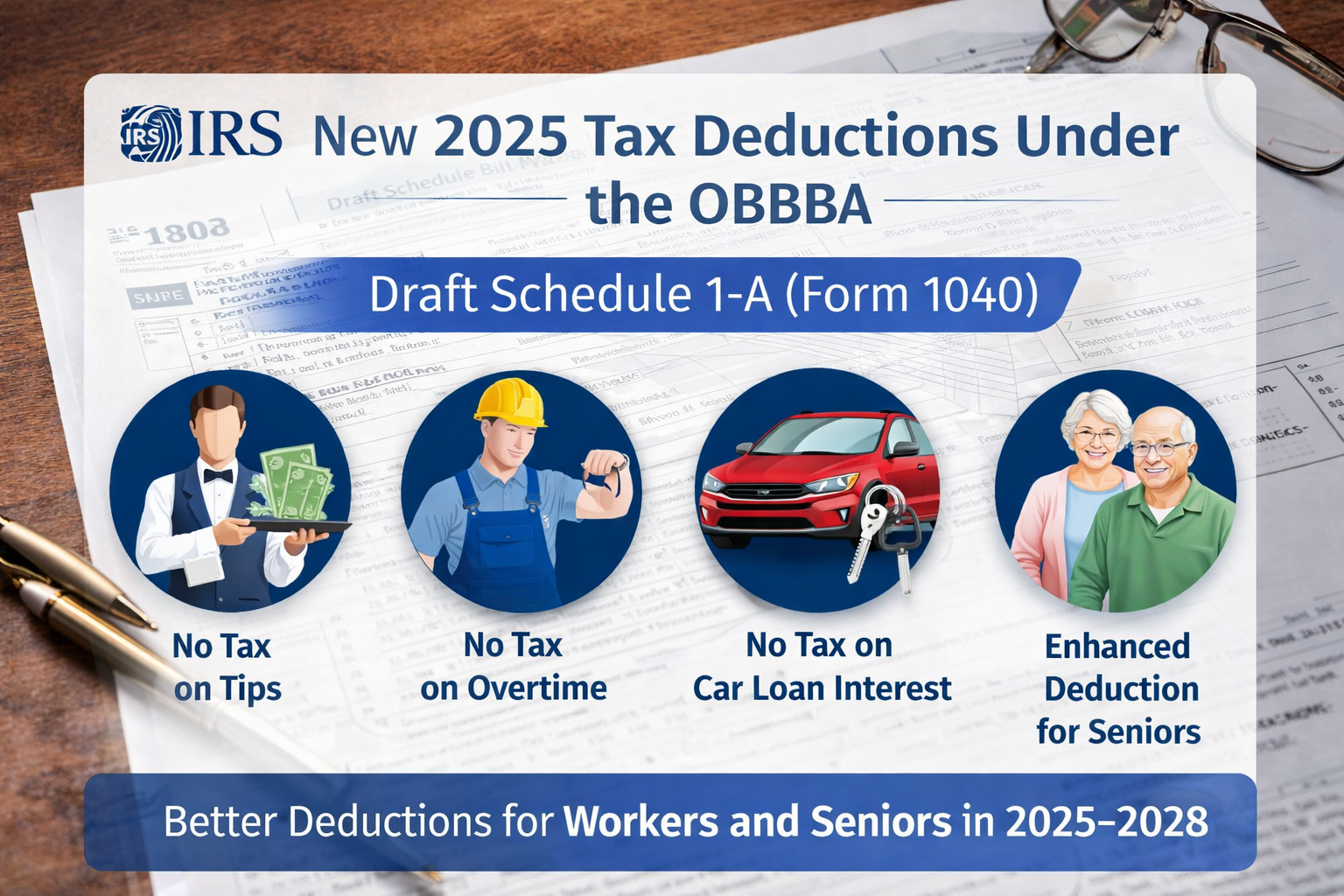
IRS Releases Draft Schedule 1-A for New 2025 Tax Deductions Under the OBBBA

The IRS has released a draft of Schedule 1-A (Form 1040), introducing a new reporting structure for several deductions created under the One Big Beautiful Bill Act (OBBBA). These new tax deductions — available from 2025 through 2028 — are designed to provide targeted relief for workers and seniors.

The draft form represents one of the first major implementation steps for the new law and outlines how taxpayers will claim deductions for:

  • Tips
  • Overtime pay
  • Car loan interest
  • An enhanced deduction for seniors

If you’re planning ahead for the 2025 tax year, understanding how these provisions work could create meaningful tax planning opportunities.

What Is Schedule 1-A (Form 1040)?

Schedule 1-A is a newly proposed IRS form that consolidates several OBBBA deductions into one reporting schedule. These deductions are classified as “below-the-line” deductions, meaning:

  • They reduce taxable income
  • They do not reduce Adjusted Gross Income (AGI)
  • They can be claimed whether or not you itemize deductions

While marketed as “no tax” provisions, these are technically income deductions, not exclusions. Taxpayers must still report income properly — the deduction simply lowers taxable income subject to federal tax.

Breakdown of the Four New 2025–2028 Tax Deductions

1. No Tax on Tips Deduction (2025–2028)

This deduction benefits service industry workers who receive reported tips.

Who Qualifies?

Employees receiving qualified tips reported on:

  • Form W-2
  • Form 1099-NEC
  • Form 1099-MISC
  • Form 1099-K

Deduction Limit

Up to $25,000 per filer

Income Phaseout Begins At:

  • $150,000 Modified Adjusted Gross Income (MAGI) for single filers
  • $300,000 MAGI for married filing jointly

Additional Requirements

  • Valid Social Security number
  • Married taxpayers must file jointly

Example

A server reporting $20,000 in qualified tips could deduct that amount, subject to income phaseout limits.

SEO keywords: no tax on tips deduction 2025, tip income tax deduction, OBBBA tips deduction

2. No Tax on Overtime Deduction

Designed to benefit hourly workers, this provision allows a deduction for qualified overtime pay.

Who Qualifies?

Wage earners receiving federally required overtime compensation under the Fair Labor Standards Act (FLSA).

Only the additional “half” portion of time-and-a-half pay qualifies.

Deduction Limit

  • $12,500 per filer
  • $25,000 for joint filers

Income Phaseout Begins At:

  • $150,000 MAGI (single)
  • $300,000 MAGI (joint)

Important Limitation

State-specific overtime rules do not qualify — only federally mandated overtime applies.

Example

An eligible employee with $10,000 in qualified overtime earnings may deduct that amount, subject to phaseout rules.

SEO keywords: overtime tax deduction 2025, no tax on overtime OBBBA, FLSA overtime deduction

3. No Tax on Car Loan Interest Deduction

This new deduction allows taxpayers to deduct interest paid on certain new vehicle purchases.

Who Qualifies?

Taxpayers who:

  • Purchased a new personal-use vehicle after December 31, 2024
  • The vehicle is assembled in the United States
  • Has a gross vehicle weight rating under 14,000 pounds
  • The purchase is secured by a loan lien

Deduction Limit

Up to $10,000 per filer for interest paid

Income Phaseout Begins At:

  • $100,000 MAGI (single)
  • $200,000 MAGI (joint)

Exclusions

  • Used vehicles
  • Leased vehicles
  • Business-use vehicle loans

Example

A married couple paying $6,500 in interest on a qualified auto loan with MAGI below $200,000 could deduct the full $6,500.

SEO keywords: car loan interest deduction 2025, auto loan tax deduction OBBBA, new vehicle tax deduction

4. Enhanced Deduction for Seniors (Age 65+)

The OBBBA also provides additional tax relief for retirees.

Who Qualifies?

Individuals age 65 and older with valid Social Security numbers. Married taxpayers must file jointly.

Deduction Amount

  • $6,000 per filer
  • $12,000 for joint filers

Income Phaseout Begins At:

  • $75,000 MAGI (single)
  • $150,000 MAGI (joint)

Example

A retired couple with $120,000 in MAGI may qualify for most of the enhanced deduction before phaseout reduces the benefit.

SEO keywords: senior tax deduction 2025, enhanced deduction age 65, retiree tax relief OBBBA

Important Planning Considerations for 2025

Although these provisions are branded as “no tax” measures, they:

  • Do not eliminate income reporting requirements
  • Do not reduce AGI
  • Are subject to income-based phaseouts
  • Are temporary (2025–2028 only)

The IRS is expected to release final instructions clarifying documentation requirements and calculation methods before the 2025 filing season.

Because these deductions are temporary, strategic timing of income, vehicle purchases, and retirement distributions may be especially important during the 2025–2028 window.

What This Means for Tax Planning

The introduction of Schedule 1-A signals a structural change in how individual tax deductions will be reported beginning in 2025.

Workers who earn significant tips or overtime, individuals planning to purchase a vehicle, and retirees over age 65 should begin evaluating how these changes could impact taxable income projections.

At Reckenen, we monitor legislative developments and IRS implementation guidance to help clients plan proactively — not reactively. Early analysis can help maximize available deductions while avoiding unintended phaseout limitations.

If you’d like guidance on how the new 2025 tax deductions under the OBBBA may apply to your specific situation, our team is available to help you build a forward-looking tax strategy.

Share insights

Email
Facebook
X
LinkedIn

Professional tax return preparation helps reduce filing errors by ensuring that all financial information is accurate, complete, and properly reviewed before submission. Tax professionals check income, deductions, and documents carefully, which reduces mistakes like wrong calculations or missing details.

They also stay updated with tax laws and use the correct forms and filing status. This lowers the risk of penalties, delays, and IRS issues, making the entire tax filing process more accurate and stress-free with Reckenen. 

What is Tax Return Preparation?

Tax return preparation is the process of collecting financial information and filing it with the tax authorities in an accurate and legal way. It includes reporting income, claiming deductions and credits, calculating taxes owed or refunds, and submitting the required forms to the IRS or relevant tax department.

In simple words, tax return preparation means organizing your financial details and filing your taxes correctly so you pay the right amount and avoid penalties or errors. A proper tax due diligence list is often used by professionals to ensure nothing is missed.

Why Tax Filing Errors Matter

Filing taxes may look simple, but even a small mistake can cause serious problems. Errors can lead to penalties, delayed refunds, or even IRS audits. Many people think they can manage it alone, but tax rules are complex and change often.

Most common tax mistakes happen because of missing details or wrong calculations. This is why professional tax return preparation is important. It helps reduce errors, ensures accuracy, and keeps everything compliant with tax laws. 

Why Professional Tax Preparation Matters

Tax filing errors can create serious financial and legal problems. From penalties to audits, the risks are real and often avoidable.

Professional tax return preparation helps ensure accuracy, compliance, and better financial outcomes. It reduces stress, saves time, and protects taxpayers from costly mistakes. A tax expert can help handle complex filings more safely. In today’s complex tax environment, choosing professional support like a tax filing pro, for short, is not just helpful; it is a smart decision. 

Common Tax Filing Errors Taxpayers Make

Many taxpayers make similar mistakes without realizing it. These include reporting incorrect income, missing deductions or credits, making calculation errors, and choosing the wrong filing status. Some people also forget to attach required forms or make simple data entry mistakes while filing manually.

Even one small tax filing error can change the final tax amount and create issues with the IRS. 

Why Errors Happen in Self-Prepared Tax Returns

Self-prepared tax returns often contain mistakes because most people are not fully aware of tax laws. Rules change frequently, and it becomes difficult to keep up with updates.

Another major reason is misunderstanding deductions and credits. Many taxpayers either miss benefits they qualify for or claim them incorrectly. Poor record-keeping throughout the year also leads to confusion during filing. Some people rely too much on software or AI tools, but without proper knowledge, mistakes still happen when users try to get their own tax filing done without support.

How Professional Tax Preparers Reduce Filing Errors

  • Carefully review all financial data to ensure accuracy
  • Check that all documents are complete and correct
  • Verify every number to avoid calculation mistakes
  • Apply updated tax laws and correct deductions
  • Avoid outdated or incorrect filing practices
  • Review the entire return before submission to catch errors
  • Select the correct tax forms and filing status
  • Ensure proper income reporting and classification.

Professionals also follow a structured tax due diligence list to ensure accuracy at every step. 

Role of Due Diligence in Tax Preparation

Due diligence means carefully checking all tax information before filing. It is an important part of professional tax preparation.

Tax experts verify income details, review deductions, and ensure that all claims are accurate. This process reduces the chances of errors and helps maintain compliance with tax regulations. It also lowers the risk of penalties and builds confidence in the final return.

How Professional Tax Preparation Helps Avoid IRS Penalties

IRS penalties usually happen when there are errors in reporting or missing information. Professional tax preparation helps avoid these problems by ensuring everything is correct before submission.

It prevents incorrect deductions, reduces the chances of underreporting income, and ensures that tax returns are filed on time. Proper documentation is also maintained, which is very important in case of an audit. This reduces stress and protects taxpayers from unnecessary financial loss.

Benefits of Using Professional Tax Services

  • Higher accuracy in tax returns, reducing the risk of penalties
  • Saves time by handling complex calculations and paperwork
  • Identifies tax-saving opportunities that are often missed
  • Ensures proper compliance with tax laws
  • Provides peace of mind during tax season

When You Should Not Rely Only on DIY or AI Tools

DIY tools may work for simple tax situations, but they are not always reliable for complex cases. If you have business income, multiple income sources, investments, or rental properties, professional help becomes necessary.

Major financial changes during the year can also make tax filing more complicated. In such cases, relying only on software or AI tools increases the risk of tax filing errors. When accuracy and compliance are important, professional support is the better choice.

Professional vs DIY Tax Filing Comparison

DIY tax filing may seem cost-effective, but it comes with higher risk. Many people miss deductions or make mistakes that cost them more in the long run.

Professional tax preparation, on the other hand, follows a structured process. Experts review every detail and ensure compliance with tax laws. This leads to better accuracy and reduces the chances of audits. In simple terms, DIY saves money upfront, but professional services like a tax filing pro for short save money in the long run. 

FAQs

  1. Why should I use a professional tax preparer?

A professional tax preparer helps ensure your tax return is accurate and complete. They also help you avoid errors, reduce penalties, and find possible tax savings.

  1. What process do professionals use to ensure accuracy?

They review all financial documents, cross-check data, apply updated tax laws, and verify calculations before filing. This step-by-step process reduces mistakes.

  1. What are the cons of using a professional tax preparer?

The main drawback is the cost of the service. However, this cost is often lower than the penalties or losses caused by filing errors.

  1. Are tax preparers responsible for mistakes?

Tax preparers are responsible for the work they do, but the taxpayer is also legally responsible for the final return. That is why choosing a qualified professional is important.

  1. When should I hire a professional tax preparer?

You should consider hiring one if you have complex finances or want to reduce tax filing errors and ensure full compliance. 

File Smart, Stay Safe 

Tax mistakes can cost more than you think, but they are avoidable. Professional tax return preparation brings accuracy, compliance, and peace of mind by catching errors before they become problems. Instead of risking penalties or delays, you get a smooth, reliable filing process. In simple terms, working with a professional is not just about filing taxes; it’s about protecting your money, your time, and your financial future.

Avoid costly mistakes; trust Reckenen to get your taxes right the first time.