
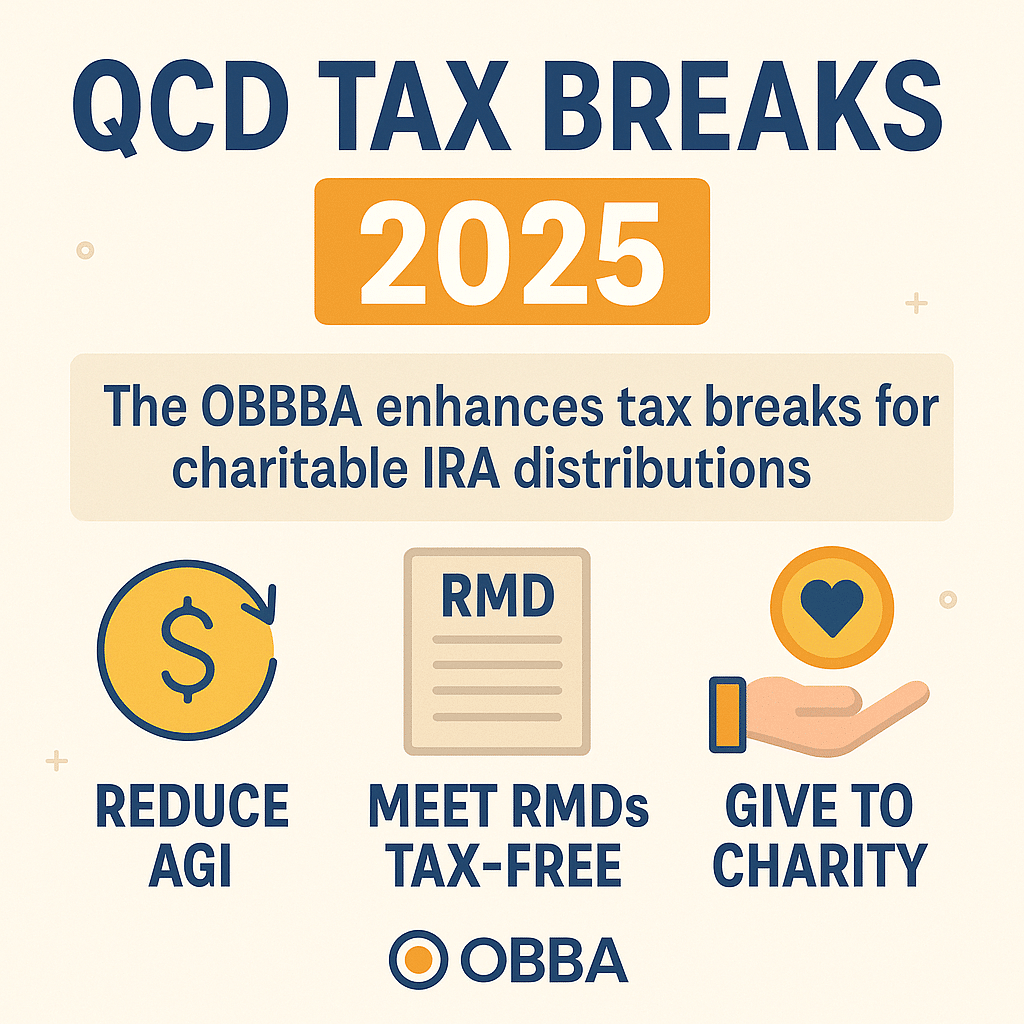
The Hidden Tax Strategy in the OBBBA: Bigger Breaks for Charitable IRA Distributions

Qualified Charitable donations from your IRA

If you’re age 70½ or older, there’s a little-known way to give to charity that can significantly reduce your taxes: making a qualified charitable distribution (QCD) directly from your IRA.

The One Big Beautiful Bill Act (OBBBA) has expanded the benefits of this strategy, creating more opportunities for retirees to lower their taxable income while supporting the causes they care about. Here’s what’s changed — and why QCDs may be one of the most effective giving tools for 2025 and beyond.


What Is a Qualified Charitable Distribution (QCD)?

A QCD lets you send funds directly from your traditional IRA to an IRS-approved charity without paying income tax on the amount transferred. It’s not treated as an itemized deduction — it’s simply excluded from income altogether.

You must be at least age 70½, and the transfer must go directly from your IRA custodian to the charity. You cannot receive any benefit (such as tickets, goods, or services) in return, and QCDs can’t come from a SEP or SIMPLE IRA.

For 2025, you may give up to $108,000 per person — and if you’re married, each spouse with their own IRA can give up to that amount.


Why QCDs Are More Powerful After the OBBBA

Because the OBBBA introduced new income-based limits and phaseouts, keeping your adjusted gross income (AGI) low is more valuable than ever. QCDs don’t increase AGI, which allows taxpayers to avoid or minimize several hidden tax costs.

With QCDs, you can:
• Avoid being bumped into a higher tax bracket.
• Bypass the 60% of AGI cap on charitable deductions.
• Sidestep the new 0.5% AGI floor on charitable write-offs (starting 2026).
• Avoid itemized deduction reductions for high earners.
• Preserve the new Senior Bonus Deduction (up to $6,000 per spouse).
• Keep the expanded SALT deduction ($40,000 in 2025) fully available.
• Prevent the 3.8% Net Investment Income Tax from being triggered.
• Lower your Medicare IRMAA premiums by keeping MAGI down.

In essence, QCDs help you maintain access to deductions and credits that might otherwise disappear due to income thresholds — all while making a charitable impact.


QCDs Can Satisfy Your Required Minimum Distributions (RMDs)

Once you reach age 73, the IRS requires you to take annual minimum distributions (RMDs) from your retirement accounts. Those RMDs are normally taxable, but QCDs can count toward that requirement without being taxed.

For example, if your RMD is $20,000 and you give $20,000 directly from your IRA to a charity, you’ve met your RMD obligation with zero tax owed.

Timing matters: the QCD must occur before taking your RMD for it to count. Once you’ve withdrawn an RMD into your own account, it can’t be retroactively converted into a QCD.


Tax Coordination for Non-Deductible IRA Contributions

If your IRA includes both deductible and non-deductible contributions, QCDs are treated as coming from the taxable portion first. The benefit: your QCDs remain tax-free, and the non-deductible (basis) portion stays in your account for future tax-free withdrawals.

This structure allows you to maintain long-term flexibility while still meeting charitable and tax planning goals.


Estate and Legacy Benefits

Even though the federal estate tax exemption is currently very high ($13.99 million for individuals and roughly $28 million for married couples in 2025), QCDs can help reduce future estate exposure by removing assets from your taxable estate.

For families with philanthropic goals, this is a simple, direct, and IRS-compliant way to build charitable giving into a legacy strategy.


Important Limitations for Post-70½ IRA Contributions

Since 2020, individuals over age 70½ can make IRA contributions if they have earned income. However, any deductible contributions made after turning 70½ reduce the portion of future QCDs that can be excluded from income.

In other words, if you’ve made post-70½ deductible IRA contributions, your first few QCDs might not be fully tax-free until those contributions are “offset.”


How to Report QCDs on Your Tax Return

On your Form 1040, report the full amount of IRA distributions (including QCDs) on Line 4a, and only the taxable portion (if any) on Line 4b — write “QCD” next to the line.

If you have any non-deductible IRA basis, file Form 8606 to report the remaining basis and confirm the nontaxable portion.


Who Should Consider QCDs

You may benefit from using QCDs if:
• You claim the standard deduction and don’t itemize charitable gifts.
• You’re required to take RMDs but don’t need the extra income.
• You want to reduce AGI to preserve other tax deductions and credits.
• You want to simplify charitable giving and estate planning.

With an annual limit of $108,000 per person ($216,000 for couples), QCDs provide one of the most flexible and tax-efficient ways to give during retirement.


Key Takeaway

QCDs are one of the rare tax planning strategies that combine generosity and efficiency. They allow retirees to give directly from IRAs, satisfy RMDs, reduce taxable income, and keep more deductions and credits intact — all under the expanded benefits of the OBBBA.

👉 IRS – Qualified Charitable Distributions (QCDs)
👉 Medicare IRMAA Premium Information
👉 Reckenen Tax Planning Services
👉 Schedule a Consultation


Legal Disclaimer
This information is for general educational purposes only and should not be construed as legal, accounting, or tax advice. You should consult your tax advisor regarding your specific circumstances before making financial or charitable decisions. Tax laws are subject to change, and interpretations vary based on individual situations.

Share insights

Email
Facebook
X
LinkedIn

Professional tax return preparation helps reduce filing errors by ensuring that all financial information is accurate, complete, and properly reviewed before submission. Tax professionals check income, deductions, and documents carefully, which reduces mistakes like wrong calculations or missing details.

They also stay updated with tax laws and use the correct forms and filing status. This lowers the risk of penalties, delays, and IRS issues, making the entire tax filing process more accurate and stress-free with Reckenen. 

What is Tax Return Preparation?

Tax return preparation is the process of collecting financial information and filing it with the tax authorities in an accurate and legal way. It includes reporting income, claiming deductions and credits, calculating taxes owed or refunds, and submitting the required forms to the IRS or relevant tax department.

In simple words, tax return preparation means organizing your financial details and filing your taxes correctly so you pay the right amount and avoid penalties or errors. A proper tax due diligence list is often used by professionals to ensure nothing is missed.

Why Tax Filing Errors Matter

Filing taxes may look simple, but even a small mistake can cause serious problems. Errors can lead to penalties, delayed refunds, or even IRS audits. Many people think they can manage it alone, but tax rules are complex and change often.

Most common tax mistakes happen because of missing details or wrong calculations. This is why professional tax return preparation is important. It helps reduce errors, ensures accuracy, and keeps everything compliant with tax laws. 

Why Professional Tax Preparation Matters

Tax filing errors can create serious financial and legal problems. From penalties to audits, the risks are real and often avoidable.

Professional tax return preparation helps ensure accuracy, compliance, and better financial outcomes. It reduces stress, saves time, and protects taxpayers from costly mistakes. A tax expert can help handle complex filings more safely. In today’s complex tax environment, choosing professional support like a tax filing pro, for short, is not just helpful; it is a smart decision. 

Common Tax Filing Errors Taxpayers Make

Many taxpayers make similar mistakes without realizing it. These include reporting incorrect income, missing deductions or credits, making calculation errors, and choosing the wrong filing status. Some people also forget to attach required forms or make simple data entry mistakes while filing manually.

Even one small tax filing error can change the final tax amount and create issues with the IRS. 

Why Errors Happen in Self-Prepared Tax Returns

Self-prepared tax returns often contain mistakes because most people are not fully aware of tax laws. Rules change frequently, and it becomes difficult to keep up with updates.

Another major reason is misunderstanding deductions and credits. Many taxpayers either miss benefits they qualify for or claim them incorrectly. Poor record-keeping throughout the year also leads to confusion during filing. Some people rely too much on software or AI tools, but without proper knowledge, mistakes still happen when users try to get their own tax filing done without support.

How Professional Tax Preparers Reduce Filing Errors

  • Carefully review all financial data to ensure accuracy
  • Check that all documents are complete and correct
  • Verify every number to avoid calculation mistakes
  • Apply updated tax laws and correct deductions
  • Avoid outdated or incorrect filing practices
  • Review the entire return before submission to catch errors
  • Select the correct tax forms and filing status
  • Ensure proper income reporting and classification.

Professionals also follow a structured tax due diligence list to ensure accuracy at every step. 

Role of Due Diligence in Tax Preparation

Due diligence means carefully checking all tax information before filing. It is an important part of professional tax preparation.

Tax experts verify income details, review deductions, and ensure that all claims are accurate. This process reduces the chances of errors and helps maintain compliance with tax regulations. It also lowers the risk of penalties and builds confidence in the final return.

How Professional Tax Preparation Helps Avoid IRS Penalties

IRS penalties usually happen when there are errors in reporting or missing information. Professional tax preparation helps avoid these problems by ensuring everything is correct before submission.

It prevents incorrect deductions, reduces the chances of underreporting income, and ensures that tax returns are filed on time. Proper documentation is also maintained, which is very important in case of an audit. This reduces stress and protects taxpayers from unnecessary financial loss.

Benefits of Using Professional Tax Services

  • Higher accuracy in tax returns, reducing the risk of penalties
  • Saves time by handling complex calculations and paperwork
  • Identifies tax-saving opportunities that are often missed
  • Ensures proper compliance with tax laws
  • Provides peace of mind during tax season

When You Should Not Rely Only on DIY or AI Tools

DIY tools may work for simple tax situations, but they are not always reliable for complex cases. If you have business income, multiple income sources, investments, or rental properties, professional help becomes necessary.

Major financial changes during the year can also make tax filing more complicated. In such cases, relying only on software or AI tools increases the risk of tax filing errors. When accuracy and compliance are important, professional support is the better choice.

Professional vs DIY Tax Filing Comparison

DIY tax filing may seem cost-effective, but it comes with higher risk. Many people miss deductions or make mistakes that cost them more in the long run.

Professional tax preparation, on the other hand, follows a structured process. Experts review every detail and ensure compliance with tax laws. This leads to better accuracy and reduces the chances of audits. In simple terms, DIY saves money upfront, but professional services like a tax filing pro for short save money in the long run. 

FAQs

  1. Why should I use a professional tax preparer?

A professional tax preparer helps ensure your tax return is accurate and complete. They also help you avoid errors, reduce penalties, and find possible tax savings.

  1. What process do professionals use to ensure accuracy?

They review all financial documents, cross-check data, apply updated tax laws, and verify calculations before filing. This step-by-step process reduces mistakes.

  1. What are the cons of using a professional tax preparer?

The main drawback is the cost of the service. However, this cost is often lower than the penalties or losses caused by filing errors.

  1. Are tax preparers responsible for mistakes?

Tax preparers are responsible for the work they do, but the taxpayer is also legally responsible for the final return. That is why choosing a qualified professional is important.

  1. When should I hire a professional tax preparer?

You should consider hiring one if you have complex finances or want to reduce tax filing errors and ensure full compliance. 

File Smart, Stay Safe 

Tax mistakes can cost more than you think, but they are avoidable. Professional tax return preparation brings accuracy, compliance, and peace of mind by catching errors before they become problems. Instead of risking penalties or delays, you get a smooth, reliable filing process. In simple terms, working with a professional is not just about filing taxes; it’s about protecting your money, your time, and your financial future.

Avoid costly mistakes; trust Reckenen to get your taxes right the first time.