
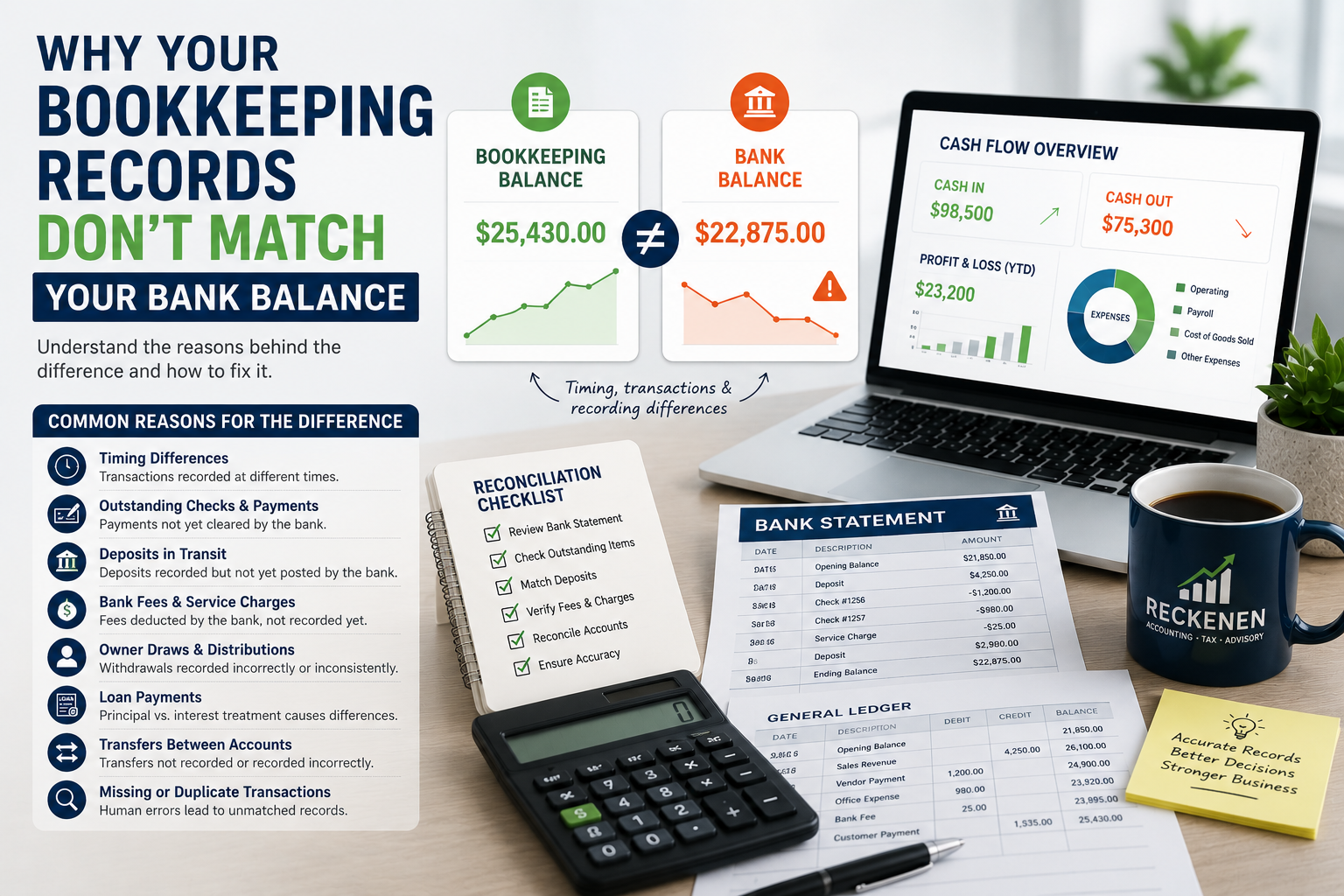
In short, bookkeeping records and bank balances often do not match because of timing differences, outstanding transactions, bank fees, loan activity, owner withdrawals, or bookkeeping errors. While some differences are temporary and completely normal, others may indicate issues that require immediate attention. Understanding the cause of the discrepancy is the first step toward maintaining accurate financial records and making informed business decisions.
At Reckenen, we help business owners identify bookkeeping discrepancies, maintain accurate financial records, and gain better visibility into their financial performance. In this guide, we explain why bookkeeping records and bank balances may not match, what causes these discrepancies, and how to resolve them.
What Are Bookkeeping Records?
Bookkeeping records track your business’s financial activity. They include income, expenses, assets, liabilities, payroll transactions, loan balances, and owner contributions or distributions.
Accounting software records these transactions throughout the year and uses them to generate financial reports such as:
- Profit and loss statements
- Balance sheets
- Cash flow statements
These records help business owners understand financial performance and make informed decisions.
What Is a Bank Balance?
A bank balance reflects the amount of money currently available in your bank account.
While your bookkeeping system records all financial activity, your bank statement only shows transactions that have cleared through the bank. As a result, your bookkeeping records and bank balance may not always match on the same day. Understanding this distinction helps business owners avoid confusion when reviewing financial reports.
The Real Reason Your Bookkeeping and Bank Balance Don’t Match
Several factors can cause differences between accounting records and bank balances.
Timing Differences
Timing differences are one of the most common reasons for discrepancies.
For example, you may record a customer payment today, but the funds may not appear in your bank account until several days later. Similarly, checks may be issued but not yet cashed.
As a result, temporary differences between records and bank balances often occur.
Outstanding Checks and Payments
Checks, electronic transfers, and bill payments do not always clear immediately.
When payments remain outstanding, bookkeeping records may show the transaction while the bank account does not. Consequently, balances may appear different until the transaction clears.
Deposits in Transit
Businesses often record deposits before banks fully process them.
Although the deposit appears in your accounting records, it may not yet appear on the bank statement. Therefore, deposits in transit frequently create temporary discrepancies.
Bank Fees and Service Charges
Banks may deduct service charges, wire fees, overdraft fees, or other expenses directly from your account. If these transactions are not recorded in your bookkeeping system, balances will no longer match.
Owner Draws and Distributions
Owner withdrawals create confusion for many small business owners.
If owner draws are categorized incorrectly as business expenses, financial reports may become inaccurate. In addition, improper recording can create differences between bookkeeping records and bank balances.
Loan Payments
Loan payments often contain both principal and interest components. While interest may appear as an expense, principal payments reduce liabilities rather than affecting profit. Consequently, loan transactions frequently create confusion when business owners compare financial statements to bank activity.
Transfers Between Accounts
Many businesses transfer funds between checking accounts, savings accounts, payroll accounts, or merchant accounts. If transfers are recorded incorrectly, duplicated, or omitted, account balances may not reconcile properly.
Missing or Duplicate Transactions
Human error remains a common cause of discrepancies. For example, transactions may be entered twice, omitted completely, or assigned to the wrong account. As a result, bookkeeping records may no longer reflect actual bank activity.
Common Sources of Reconciliation Differences
Source of Difference | How It Appears | Potential Impact | Typical Corrective Action |
Outstanding checks | The book balance is lower than the bank balance | Temporary reporting differences | Verify clearing dates |
Deposits in transit | The book balance is higher than the bank balance | Temporary reconciliation issues | Confirm bank posting dates |
Duplicate transactions | Income or expenses appear twice | Inaccurate financial reports | Remove duplicate entries |
Unrecorded bank fees | Bank balance is lower than the book balance | Overstated cash position | Record bank charges |
Misclassified transactions | Transactions appear in incorrect accounts | Distorted financial reporting | Reclassify transactions correctly |
Missing transactions | Records are incomplete | Inaccurate bookkeeping and tax reporting | Review source documents |
Transfer errors | Account balances do not reconcile | Incorrect cash balances | Verify transfer entries |
Loan payment errors | Liabilities and expenses are misstated | Financial statement inaccuracies | Review loan allocations |
Reviewing these differences regularly helps businesses maintain accurate bookkeeping records and reduce the risk of financial reporting errors. In addition, monthly reconciliations make it easier to identify problems before they affect cash flow, decision-making, or tax compliance.
What Each Report Is Trying to Tell You
Many business owners compare bookkeeping reports directly to bank balances. However, each serves a different purpose. Your bookkeeping records provide a complete picture of business performance, assets, liabilities, and profitability.
Your bank balance simply shows how much cash is currently available in a specific account. Therefore, neither report is more important than the other. Instead, both reports work together to help business owners understand their overall financial position.
Common Mistakes Small Business Owners Make
Several bookkeeping mistakes can increase reconciliation issues.
Common examples include:
- Skipping monthly bank reconciliations
- Categorizing transactions incorrectly
- Recording owner draws as expenses
- Failing to track loan balances properly
- Ignoring bank service charges
- Creating duplicate transactions
- Forgetting to record deposits
Over time, these mistakes can affect financial reporting, tax preparation, and cash flow management.
Why This Problem Can Cost Businesses Money
Small discrepancies often seem harmless. However, unresolved bookkeeping issues can become expensive.
Inaccurate records may lead to:
- Poor business decisions
- Incorrect financial reporting
- Cash flow problems
- Missed tax deductions
- Tax filing errors
- Difficulty securing financing
- Increased audit risk
Therefore, addressing discrepancies early helps protect both financial accuracy and business growth.
How to Use Both Reports Together
The most effective approach is to review bookkeeping records and bank statements together.
Regular reconciliations allow business owners to:
- Verify transaction accuracy
- Identify missing entries
- Detect duplicate transactions
- Confirm account balances
- Improve financial visibility
As a result, financial reports become more reliable and useful for decision-making.
A Practical Process to Reconcile the Mismatch
When bookkeeping records and bank balances do not match, follow a structured process.
Step 1: Compare Beginning Balances
Start by confirming that beginning balances match previous reconciled records.
Step 2: Review Outstanding Transactions
Identify checks, deposits, and payments that have not yet cleared.
Step 3: Verify Bank Fees and Interest
Confirm that bank fees, interest income, and service charges have been recorded correctly.
Step 4: Review Transfers and Loan Activity
Check transfers between accounts and verify that loan payments have been recorded properly.
Step 5: Investigate Unexplained Differences
If discrepancies remain, review transaction history carefully for missing, duplicate, or incorrectly categorized entries.
Signs the Problem May Be Bigger Than Timing
While timing differences are normal, certain warning signs may indicate deeper bookkeeping issues.
Watch for:
- Recurring reconciliation discrepancies
- Large unexplained balance differences
- Missing supporting documentation
- Frequent duplicate transactions
- Significant account adjustments
- Financial reports that seem inaccurate
If these issues occur regularly, professional bookkeeping support may be necessary.
How Professional Bookkeeping Helps Prevent Mismatches
Consistent bookkeeping creates accurate financial records and reduces reconciliation issues.
Professional bookkeeping services help businesses:
- Maintain accurate transaction records
- Perform regular reconciliations
- Monitor cash flow
- Track liabilities correctly
- Improve financial reporting accuracy
- Support tax compliance
As a result, business owners gain greater confidence in their financial information.
How Reckenen CPA Can Help
At Reckenen CPA, we help small businesses maintain accurate bookkeeping records through professional accounting, bookkeeping, tax planning, and advisory services.
Our team performs detailed account reconciliations, identifies discrepancies, improves financial visibility, and helps business owners make informed decisions based on reliable financial data.
The Bottom Line
A mismatch between bookkeeping records and bank balances does not always mean something is wrong. In many cases, timing differences create temporary discrepancies.
However, recurring mismatches should never be ignored. Regular reconciliations, accurate bookkeeping, and proactive financial oversight help ensure your records remain accurate and your business stays financially healthy.
Need help resolving bookkeeping discrepancies? Contact Reckenen CPA for expert bookkeeping, accounting, and financial advisory support.
FAQs:
If my bookkeeping records show a profit but my bank balance is low, is that normal?
Yes. Profit and cash are not the same thing. A business can be profitable while experiencing cash flow challenges due to unpaid invoices, inventory purchases, debt payments, or tax obligations.
Why do loan payments affect my bank account differently from my financial statements?
Loan payments often include both principal and interest. Interest appears as an expense, while principal reduces a liability account. Therefore, loan activity affects financial statements differently from bank balances.
Does an owner’s draw affect business profit?
No. Owner draws reduce equity rather than business profit. However, they do reduce available cash in the bank account.
How often should bank reconciliations be performed?
Most businesses should reconcile accounts monthly. However, companies with high transaction volumes may benefit from more frequent reconciliations.
What is the most important number to monitor for daily operations?
Cash availability is often one of the most important metrics for daily operations because it determines whether the business can meet short-term financial obligations.